
Nikon Coolpix P500 Instruction Manual: A Comprehensive Guide
This manual details the Nikon COOLPIX P500, a high-functionality compact camera released in 2011, offering users a complete guide to its features and operation.
Welcome to the world of the Nikon Coolpix P500! This powerful compact camera, introduced by Nikon UK in February 2011, represents a significant step forward in combining high performance with portability. Designed for photography enthusiasts, the P500 boasts a versatile feature set packed into a relatively small body.
This instruction manual serves as your comprehensive guide to unlocking the full potential of your new camera. Whether you’re a seasoned photographer or just beginning your journey, this guide will walk you through every aspect of the P500, from initial setup and basic operation to advanced techniques and troubleshooting. Prepare to explore a world of creative possibilities with the Nikon Coolpix P500!
Unboxing and Initial Setup
Carefully unpack your Nikon Coolpix P500 and verify that all included accessories are present. These typically include the camera body, battery, battery charger, USB cable, and this instruction manual. Before first use, fully charge the battery using the provided charger – a full charge usually takes several hours.
Insert the charged battery into the designated compartment. Next, insert a compatible SD memory card (not included) into the card slot to store your photos and videos. Power on the camera and follow the on-screen prompts to set the initial language, date, and time. Congratulations, your P500 is now ready for action!
Camera Overview: Buttons and Controls
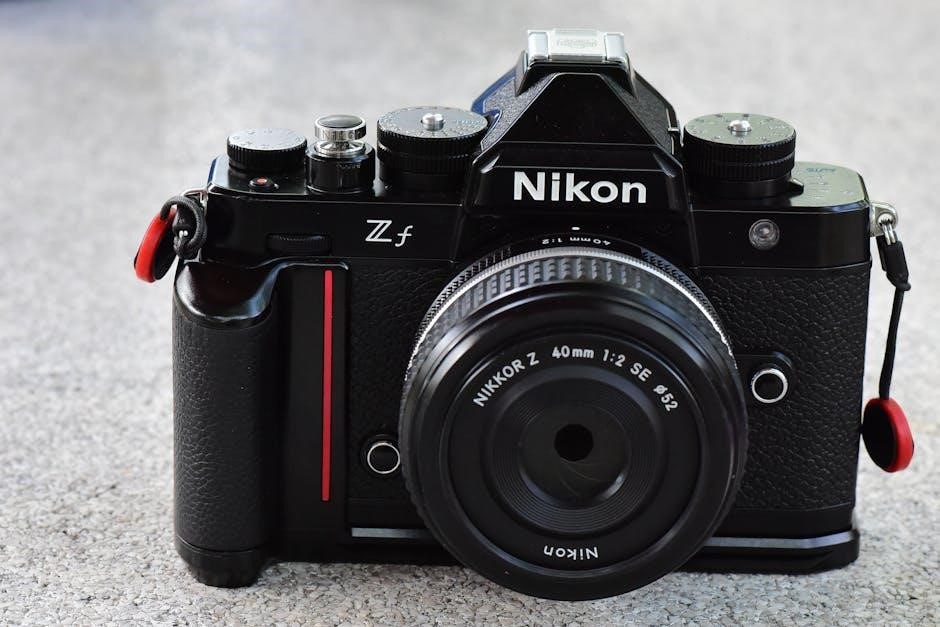
The Nikon Coolpix P500 features a thoughtfully designed layout for intuitive operation. The Mode Dial, prominently positioned on top, selects shooting modes like Auto, Scene, and Manual. Surrounding the lens is the zoom control, enabling a substantial optical zoom range. On the rear panel, you’ll find a dedicated shutter button, a command dial for menu navigation, and a directional pad for focusing point selection.
The ‘Menu’ button accesses the camera’s extensive settings. A playback button allows quick review of captured images. Familiarize yourself with these controls to efficiently navigate the camera’s functions and unlock its full potential.
Understanding the Mode Dial
The Mode Dial on the Nikon Coolpix P500 is central to camera operation. In Auto mode, the camera handles all settings for effortless shooting. Scene modes, like Portrait, Landscape, and Sports, optimize settings for specific situations. P (Program Auto) allows some user control while maintaining automatic exposure.
S (Shutter-priority), A (Aperture-priority), and M (Manual) provide full manual control over exposure. A dedicated Video mode initiates video recording. Understanding each mode empowers you to tailor the camera to your creative vision and shooting environment, maximizing image quality.
Navigating the Menu System
The Nikon Coolpix P500’s menu system is accessed via the MENU button. It’s logically organized into several tabs: Shooting, Flash, Setup, and others. Use the directional pad to navigate and the OK button to select options. Within each tab, you’ll find customizable settings for image quality, ISO sensitivity, white balance, and focus modes.
Explore the Setup menu to adjust date/time, language, and display settings. Familiarize yourself with the menu structure to efficiently modify camera parameters and unlock the P500’s full potential. Remember to save changes before exiting!
Basic Photography with the P500
Getting started with the Nikon Coolpix P500 is straightforward. Begin by powering on the camera and selecting the desired shooting mode using the mode dial. For beginners, ‘Auto’ mode is ideal, as it automatically adjusts settings for optimal results. Compose your shot using the LCD screen, ensuring your subject is within the frame.
Half-press the shutter button to activate autofocus, and fully press to capture the image. Experiment with different framing techniques and compositions. The P500’s intuitive interface makes basic photography accessible to all skill levels, allowing you to quickly capture memorable moments.
Shooting in Auto Mode

Auto mode on the Nikon Coolpix P500 simplifies photography, automatically selecting optimal settings for various scenes. The camera analyzes the lighting and subject, adjusting aperture, shutter speed, and ISO for balanced exposure. This mode is perfect for quick snapshots and everyday photography, requiring minimal user input.
To use Auto mode, simply turn the mode dial to ‘Auto’. Frame your subject, and the camera will handle the rest. Review the captured image on the LCD screen. Auto mode is a great starting point for new users, allowing them to learn composition without worrying about technical details.
Utilizing Scene Modes
The Nikon Coolpix P500 offers a variety of Scene Modes designed for specific shooting situations, enhancing image quality beyond Auto mode. These pre-programmed settings optimize camera parameters for landscapes, portraits, sports, night scenes, and more. Access Scene modes via the mode dial, selecting the option best suited to your subject.
Explore modes like ‘Landscape’ for vivid outdoor shots, ‘Portrait’ for flattering skin tones, or ‘Sports’ for capturing fast action. Experimenting with Scene modes allows for creative control without manual adjustments. The camera intelligently adjusts settings, ensuring optimal results in challenging conditions, delivering consistently impressive images.
Advanced Photography Features
The Nikon Coolpix P500 extends beyond automatic settings, offering advanced features for experienced photographers. These include full Manual Exposure control, allowing adjustment of aperture, shutter speed, and ISO for precise image creation. Explore creative depth-of-field effects with aperture control, freeze motion with faster shutter speeds, or enhance low-light performance using ISO settings.
Furthermore, the P500 provides diverse focusing modes, including autofocus area selection and manual focus options. Master techniques like focus locking and tracking moving subjects. These advanced capabilities empower users to fully realize their artistic vision, achieving professional-quality results with this versatile compact camera.
Manual Exposure Control (Aperture, Shutter Speed, ISO)
The Coolpix P500’s Manual mode unlocks complete creative control. Aperture (f-stop) dictates depth of field – lower numbers for blurred backgrounds, higher for sharpness throughout. Shutter speed controls motion blur; faster speeds freeze action, slower speeds create motion trails. ISO adjusts the camera’s sensitivity to light; lower ISOs for bright conditions, higher for low light, but beware of increased noise.
Mastering these three settings is key to artistic photography. Experiment with combinations to achieve desired effects. Understand how each setting interacts to influence exposure and image quality. This mode allows photographers to override automatic settings and truly personalize their images.
Focusing Modes and Techniques
The Nikon Coolpix P500 offers several focusing modes for diverse shooting scenarios. Auto-area AF automatically selects focus points, ideal for general photography. Center-area AF focuses on the center of the frame, useful for stationary subjects. Manual Focus allows precise control, essential for challenging situations or creative effects.
Focus Lock is crucial for recomposing shots; lock focus on your subject, then adjust the framing. Utilize the focus area selection to pinpoint specific areas within the scene. Understanding these techniques ensures sharp, well-focused images, enhancing your photographic results with the P500.
Zoom Functionality and Image Stabilization
The Nikon Coolpix P500 boasts a powerful 36x optical zoom, enabling you to capture distant subjects with remarkable clarity. This extensive zoom range is complemented by Nikon’s VR (Vibration Reduction) image stabilization technology. VR minimizes blur caused by camera shake, particularly noticeable at longer focal lengths.
Utilize the zoom lever around the shutter button for smooth transitions. For optimal stability, employ a tripod when using the maximum zoom. Understanding the interplay between zoom and VR is key to achieving sharp, detailed images, even in challenging shooting conditions, maximizing the P500’s capabilities.
Understanding and Using the Flash
The Nikon Coolpix P500 incorporates a built-in flash, offering various modes to enhance your photography in low-light situations. Access flash settings through the camera’s menu system. Available modes include Auto, Red-eye reduction, Fill-flash, and Slow sync.
Auto flash automatically fires when the camera detects insufficient light. Fill-flash provides additional illumination even in bright conditions, useful for portraits. Slow sync combines flash with a slower shutter speed, ideal for capturing ambient light and subject detail. Experiment with these modes to achieve desired results, understanding their impact on image exposure and overall quality.
Recording Video with the Coolpix P500
The Nikon Coolpix P500 allows for video recording, offering a convenient way to capture moving moments. Initiate video recording by selecting the movie mode on the mode dial. The camera supports multiple video resolution and frame rates, including standard definition and high definition options.
Explore the menu settings to adjust video quality and choose appropriate frame rates for smooth playback. Audio recording options are also available, allowing you to capture sound alongside your videos. Utilize the zoom function during recording, but be mindful of potential image stabilization effects. Review recorded videos via the playback menu.
Video Resolution and Frame Rates
The Coolpix P500 offers diverse video settings to suit various recording needs. Users can select from several video resolutions, including options for standard definition (640×480) and high definition (1280×720). Higher resolutions deliver sharper, more detailed videos, but require more storage space.
Frame rates significantly impact video smoothness. Common options include 30 frames per second (fps) for realistic motion and 24 fps for a cinematic look. Experiment with different combinations of resolution and frame rate to achieve the desired visual effect. Consider the intended use of the video when choosing these settings.
Audio Recording Options
The Nikon Coolpix P500 incorporates a built-in microphone for capturing audio alongside video recordings. While offering convenience, the internal microphone’s quality is adequate for general use but may not be ideal for professional-level audio. Audio recording levels are typically set automatically, but some models may offer manual adjustment for greater control.
Wind noise reduction is a crucial feature when filming outdoors. The P500 may include settings to minimize unwanted wind interference. For superior audio quality, consider using an external microphone connected via the camera’s audio input jack, if available, to bypass the internal microphone limitations.
Image Playback and Review
The Coolpix P500’s LCD screen serves as the primary interface for reviewing captured images and videos. Pressing the playback button allows you to scroll through your photos, utilizing zoom controls for detailed inspection. Histogram display is available, aiding in assessing exposure accuracy. You can also review shooting settings applied to each image.
Deleting unwanted images is straightforward via the menu system, with options for single or multiple selections. Image protection prevents accidental deletion of important photos. The camera supports slideshow playback with customizable intervals and transitions, offering a convenient way to share memories directly on the camera.
Viewing Images on the LCD Screen
The Nikon Coolpix P500 features a bright LCD screen for clear image review. After pressing the playback button, images are displayed sequentially. Utilize the zoom lever to magnify images up to several times their original size, enabling precise detail examination. The four-way controller navigates between images; pressing ‘OK’ initiates a full-screen view.
Information displayed includes file number, shooting date, and camera settings. Histogram functionality assists in evaluating exposure. Rotate images directly on the screen for proper orientation. Playback modes offer options like slideshows with adjustable intervals and transition effects, enhancing the viewing experience.
Deleting and Protecting Images
Deleting images on the Nikon Coolpix P500 is straightforward. In playback mode, select the image and press the delete button – a confirmation prompt will appear; Multiple image deletion is possible, allowing you to select a range or all images at once. Exercise caution during bulk deletion to avoid accidental loss of valuable photos.
Protecting images prevents accidental deletion or overwriting. Select the image, then use the menu to activate the protect function. A key icon will appear on the image thumbnail, indicating protection. To unprotect, repeat the process. This feature is crucial for safeguarding important memories, ensuring they remain safe on your camera’s memory card.
Connecting to a Computer
Connecting your Nikon Coolpix P500 to a computer enables photo transfer and potential software updates. The primary method is via a standard USB cable. Ensure the camera is powered off before connecting, then switch it on. Your computer should recognize the P500 as a removable drive, allowing direct file copying.
For enhanced functionality, Nikon Transfer 2 software is recommended. This software facilitates organized photo import, automatic image sorting, and even basic editing. Download it from Nikon’s official website. It streamlines the transfer process and offers additional features beyond simple file copying, improving your workflow.
Transferring Photos via USB
Connecting your Nikon Coolpix P500 via USB is a straightforward process. First, power off the camera, then connect it to your computer using a USB cable. Switch the camera on; it will appear as a removable drive.
Simply open the drive on your computer to access the DCIM folder, containing your photos and videos. You can then drag and drop files to your desired location. This method is ideal for quick transfers. Ensure the camera remains connected until the transfer is complete to avoid data corruption. Disconnect safely through your operating system’s eject function.
Using Nikon Transfer 2 Software
Nikon Transfer 2 offers enhanced photo transfer and organization capabilities for your Coolpix P500. Download and install the software from Nikon’s official website. Connect your camera to your computer via USB as described previously.
Launch Nikon Transfer 2; it should automatically detect your camera. The software allows you to select specific images or transfer all photos at once. You can also choose a destination folder and apply basic image adjustments. Nikon Transfer 2 streamlines the import process and provides options for renaming files and creating backups, ensuring efficient workflow.
Troubleshooting Common Issues
Blurry Images: Ensure sufficient light and a stable grip. Utilize the image stabilization feature, especially at higher zoom levels. Check the focus mode; Auto-focus may struggle in low light or with fast-moving subjects. Try using focus lock.
Battery Life: Frequent use of the LCD screen and zoom drains the battery quickly. Carry a spare battery for extended shooting sessions. Ensure the battery is fully charged before use. Avoid extreme temperatures, which can affect battery performance. Consider using power-saving modes when possible.
Dealing with Blurry Images
Camera Shake: Blurriness often stems from camera movement. Employ a firm grip, bracing your elbows against your body for stability. Utilize the built-in image stabilization feature, particularly when zoomed in. A tripod is ideal for static subjects in low light.
Focus Issues: Confirm the camera is correctly focused on your subject. Experiment with different focus areas and modes (Auto, Macro, Manual). Low light can hinder autofocus; try pre-focusing on a similar subject. Ensure the lens is clean, as smudges can affect image clarity.
Battery Life and Charging
Battery Type: The Coolpix P500 utilizes a rechargeable Li-ion battery. Expect approximately 230 shots per full charge, though this varies with usage (zoom, flash, LCD brightness). Cold temperatures significantly reduce battery performance.
Charging Procedure: Use the supplied AC adapter and USB cable. Connect the camera to a power outlet. The charging indicator illuminates during charging and turns off when complete. Avoid using third-party chargers. Fully charge the battery before initial use and prolonged storage to maximize lifespan.
Maintaining Your Nikon Coolpix P500
Cleaning the Camera Body: Use a soft, dry cloth to wipe the exterior. For stubborn smudges, slightly dampen the cloth with water. Avoid harsh chemicals or abrasive cleaners. Lens Care: Employ a lens cleaning tissue and fluid specifically designed for camera lenses. Gently wipe in a circular motion.
Storage: Store the camera in a cool, dry place, away from direct sunlight and dust. Remove the battery for extended storage periods. Regularly check the battery terminals for corrosion. Protect the LCD screen from scratches by using a screen protector.
Firmware Updates and Resources
Checking for Updates: Regularly visit the official Nikon website (nikon.com) to check for firmware updates for your Coolpix P500. These updates often improve performance, add new features, or fix bugs. Update Procedure: Download the latest firmware and follow Nikon’s detailed instructions carefully. Ensure sufficient battery charge during the update process.
Online Support: Nikon’s website provides extensive support resources, including FAQs, troubleshooting guides, and downloadable manuals. User Forums: Explore online photography forums dedicated to Nikon cameras for tips, tricks, and assistance from fellow P500 users.
Specifications and Technical Details
Image Sensor: 12.2-megapixel CCD sensor. Lens: 36x optical zoom (22.5-810mm equivalent) with a maximum aperture of f/2.8-f/5.0. ISO Range: Auto, 80, 100, 200, 400, 800, 1600, 3200, and 6400. Display: 3.0-inch tilting LCD screen. Video Recording: 720p HD video at 30fps. Storage: SD/SDHC/SDXC card slot.

Connectivity: USB, HDMI. Battery: EN-EL5 battery (approximately 220 shots per charge). Dimensions: 103.8 x 82.3 x 92.5 mm. Weight: Approximately 422g (without battery and SD card). These specifications define the P500’s capabilities and performance characteristics.